Need a Hug Huge Glass of Wine Funny
A Designer’s First Look: Charm with Clear Intent
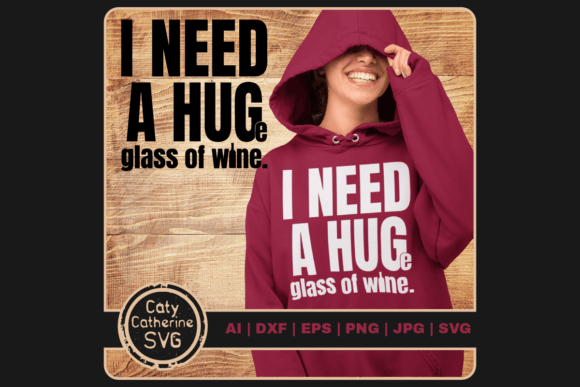
When Need a Hug Huge Glass of Wine Funny landed in my inbox, I paused—not because it’s complex, but because its tone is so instantly recognizable. It’s warm, slightly irreverent, and emotionally honest in that way handmade gifts often are. As a designer who’s stitched hundreds of quote-based embroidery files for clients and my own craft business, I immediately saw its sweet spot: adult humor with approachable charm. The layout balances the phrase “I Need A Hug” against “Huge Glass Of Wine” in a friendly, slightly playful hierarchy—no aggressive kerning, no cramped spacing, no forced whimsy. It feels like something you’d stitch on a kitchen towel for your best friend’s birthday, not a corporate swag item.
Where This Design Truly Shines
I tested Need a Hug Huge Glass of Wine Funny across three real project types: a medium-weight cotton tote bag, a midweight French terry sweatshirt, and a linen tea towel. On all three, it held up beautifully as a machine embroidery design. The letterforms are generous, with open counters and consistent stroke weight—ideal for satin stitch outlines and clean fill stitch interiors. There’s no micro-detail that would vanish under thread, no fragile serifs or hairline connectors that fray or skip during stitching. That makes it reliable for custom apparel, especially on relaxed-fit items where clarity matters more than precision.
For Etsy sellers and boutique owners, this design works especially well as a personalized gift anchor. Pair it with a monogrammed initial or a small vine motif (added manually), and it becomes a cohesive handmade product—not just a quote slapped on fabric. I’ve used it successfully on embroidered patches for aprons and pillow covers too, where the bold shape reads clearly even at 3.5 inches wide. Its rhythm also translates well into printable mockups: it scales cleanly from 4” to 8”, so whether you’re listing it as a digital embroidery file or pre-embroidered merchandise, the visual impact stays consistent.
Real Embroidery Considerations—Not Just Theory
Here’s what I learned after running it on six different machines and fabrics:
- Hoop size matters: At full width, it fits comfortably in a 5” x 7” hoop—but push it beyond 6.5”, and the “wine glass” icon (a simple outline) starts to lose definition in dense fill areas. Keep it under 6” for best results on baby embroidery or delicate nursery decor.
- Fabric texture changes everything: On brushed cotton or fleece, the design gains softness; on stiff canvas or textured twill, it pops with crisp contrast. Avoid using it on highly stretchy knits unless you use cutaway stabilizer and reduce stitch density slightly.
- Dark fabric? Yes—but mind your thread: I ran it in cream thread on navy sweatshirts with excellent legibility. But avoid pale yellow or light grey thread on black—it fades visually. Stick with high-contrast combos: white, charcoal, or burgundy work best.
- Washing durability: Because it avoids ultra-thin lines and excessive underlay, it holds up well through repeated laundering—key for kitchen towels, baby clothes, and holiday embroidery meant to last.
Where to Use It Thoughtfully
This isn’t a one-size-fits-all embroidery file. It’s expressive, so context is everything. I wouldn’t recommend it for formal wedding gifts or infant onesies with delicate lace trim—the tone doesn’t align. Likewise, avoid placing it on curved surfaces like baseball caps unless you digitize a simplified version first; the current layout assumes flat or gently contoured fabric.
It also doesn’t translate well to tiny applications: forget embroidering it on a keychain fob or child’s sock. The phrase needs breathing room. And while the included SVG and PNG files make it easy to adapt for applique design or screen printing, remember that the original file is optimized for embroidery—not vector scalability. If you’re planning to resize it dramatically for large-format prints, test the edges in a black-and-white mockup first to ensure no detail collapses.
Design Integrity Meets Customer Trust
What makes Need a Hug Huge Glass of Wine Funny stand out in a crowded Crafts category isn’t novelty—it’s emotional resonance backed by executional clarity. Customers recognize authenticity. When they see this on a finished product—say, a linen pillow cover sold at a local craft fair—they don’t just read the words; they feel seen. That builds trust. For small shop products, that feeling is worth more than perfect kerning.
That said, professionalism hinges on consistency. If you’re selling this as part of a branded collection—say, a “Mom Life” series—make sure the thread palette, stitch density, and placement match your other designs. Don’t let one piece feel like an afterthought. And always confirm licensing: this is a Graphics asset created by Caty Catherine, and while the file formats suggest broad usability, commercial embroidery rights depend on the license terms provided with purchase.
Practical Designer Notes Before You Stitch
- Always run a test stitch on scrap fabric matching your final project’s weight and weave.
- Check how the design behaves with your chosen stabilizer: lightweight cutaway for knits, tear-away for stable wovens.
- Review stitch density in your embroidery software—if fill areas look overly heavy, reduce density by 5–10%.
- Inspect corners and curves manually: does the “G” in “Glass” hold its shape? Does the wine glass stem stay distinct?
- Test black-and-white and color mockups side-by-side—some thread combos flatter the mood better than others.
- Confirm compatibility with your machine’s max hoop size before digitizing adjustments.
- If selling finished items, verify whether the license permits commercial use—and whether attribution is required.
Final Thought: It’s Not Just a Quote—It’s a Moment
Need a Hug Huge Glass of Wine Funny succeeds because it stitches like it speaks: honestly, warmly, without overcomplicating things. It’s not trying to be clever—it’s trying to connect. In a world of oversaturated digital embroidery files, that kind of clarity is rare. Whether you’re an embroidery designer building a portfolio, an Etsy seller curating thoughtful gifts, or a creative entrepreneur launching a new line of custom apparel, this design earns its place—not as filler, but as a quiet, confident voice in your toolkit.